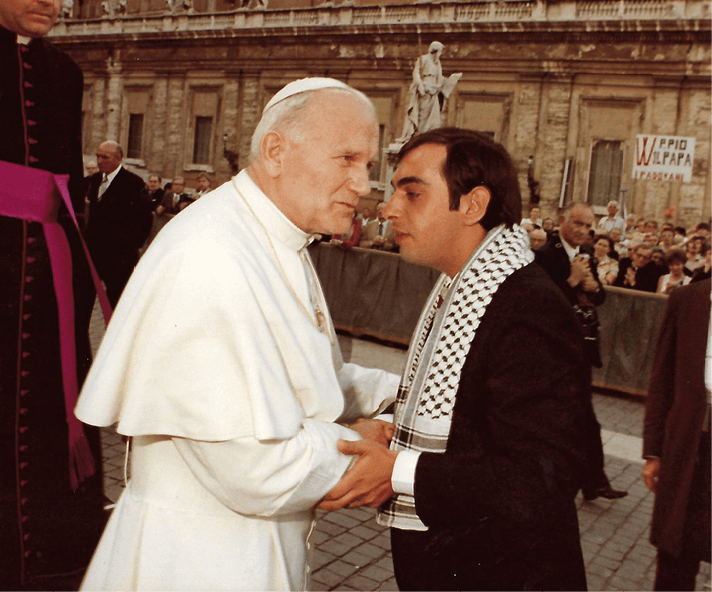
Dr. Afif Safieh, is a prominent Palestinian thinker, author, and diplomat, born 1950 in Jerusalem to a Christian family. With an illustrious career, he has served as the Palestinian Ambassador in London, Washington, Moscow, and the Vatican. Currently, Dr. Safieh is a member of Fatah’s Revolutionary Council. In this insightful interview, we delve into the dynamics of intra-Palestinian dialogues and explore arguments in favour of a two-state solution.
This interview was done over a phone call, and transcribed/arranged. Dr. Safieh’s answers were unwritten, and offer very incisive points of thought, for experts and novices alike.
- Question: Given everything that has occurred & transpired since Resolutions 181, 194, and 242, do you believe in a viable political path where the Palestinians and particularly the Israelis can fulfill the conditions to allow Palestinians the right to exercise their self-determination and self-sovereignty? Or would a one-state, with equal voting and democratic rights, be fairer in order to account for the right of return of Palestinians?
Answer: Let me first begin with the second half of your question, to elaborate a bit on the issue of one state or two state solution. I personally- I’m in favour of the two-state solution, and I believe that the discussion in certain Palestinian circles of the one station solution has been a distraction and I consider it a sign of political immaturity. Now let me tell you, I grew up, and probably your father grew up, we belonged to that generation, we grew up with the idea of the one state solution. We used to call it the unitary state, that would be democratic, where Jews, Christians, Muslims enjoy the same rights and the same obligations, and it would be bicultural, multi-confessional, pluri-ethnical, etc. We grew up with this idea, and that was our generous offer to those who chose to be our enemies. We used to tell ourselves that we have become the Jews of the Jews, but we didn’t want them, in the future, to become the Palestinians of the Palestinians.
Now what do I mean by all of that? Then, it was our generous offer to those who chose to be our enemies, we were optimistic, we naïvely thought that we were on our path to victory, and we saw the achievement of this goal, through one of two possible futures, either a decisive Arab military victory, or we succeed in convincing, converting, and seducing a majority from within the Jewish community in Palestine. That was the proposal we offered at a moment of great Palestinian optimism. Naïve optimism, but optimism, nevertheless. Now let me tell you, we never had a decisive military victory, the October war of 1973 was at best, a military draw. And all those who were in favour, among the Jewish community in Palestine, of a one state solution, I used to know them personally, and there is a limit to how many people you can know personally, and they were representing maybe only 0.05%.
So, after the October war of 1973, which was a decisive moment in regional history, and a turning point in strategic thinking, we matured and made a distinction between what is desirable, what is possible, and what is acceptable. And whoever in politics, confuses those three layers of political expectation are doomed to failure, we made a distinction between the desirable, the possible, and the acceptable, and gradually moved toward the acceptance of a two-state solution.
These days, among your generation many speak of the one state solution, and some think that it is new strategic thinking, no my friend, I personally believe it is a reheated old dish, because as I told you, I grew up in the second half of the 60s and early 70s with the idea of the one state solution. Why am I not convinced by the idea of the one state solution? Because I believe that history, and mainly the events of the last two months have proven, that what is democratically acceptable to the Israelis, is totally unacceptable to the Palestinians, and what is acceptable to the Palestinians is totally unacceptable to the Israelis. And I personally believe that the failure of the peace process from Madrid 1991, Oslo 1993 onwards, was mainly that we suffered from the self-inflicted impotence of the international community, that left the local belligerent parties to sort it out, even though there is a situation of total asymmetry. Since there is such an imbalance of power the Israelis thought that they could dictate conditions, they could dictate what is the ceiling of the possible and the permissible, and the pace of progress if any, and that is why we had all throughout those years, a durable process instead of a permanent lasting peace.
Now my friend, a one state solution I don’t see how those who are advocating this idea, propose to us to achieve it, how are we going to convince the Israelis, who feel totally superior, and by the way in our Israeli Palestinian condition, the oppressor hates the victim much more than the victim hates the oppressor. How are we going to convince them one person, one vote, and that they should accept the idea of the return of any Palestinian refugee who so desires. I don’t think we can persuade them of that. So, I believe that those who also believe that in a few years time, we will have -the Palestinians- we will be the majority, between the river and the sea, are very naïve. Because they believe if we achieve 50% plus one, that will totally change the equation. Well I believe not, in the sense that in south Africa, apartheid worked for over 40 years as an institutionalized system of discrimination but worked for two-three centuries as an unwritten constitution, in spite of the fact that the black people were 40 million, and the white people were 3 million. So, this question of us becoming 50% plus one, and that will transform, modify the equation, is a naïve expectation.
Now, why didn’t we succeed with the diplomatic path? I told you, mainly because of the fact that we witnessed the self-inflicted impotence of the international community. And in the text, I sent you of my unwritten speech in the House of Lords (placed at the end of the interview), you have some elaboration on why I am an admirer of the president Charles de Gaulle, who was president of France between 1958 – 1969, and he was a hero of the second world war, etc. So, I suggest you have a look at that document.
- Question: Has internal conflict, historically, affected the strategies and goals of the different Palestinian liberation organizations, mainly within the PLO, such as Fatah, or the PFLP, especially regarding their relationships with the international community (e.g., break-away factions performing attacks independent of their former superiors), as well as conflicting regional interests?
Answer: In the history of the PLO, we have had four presidents. We have had Ahmad Shukeiri between 1964 – 1968, we have had Yahya Hammuda as an interim president for one-year 1968 – 1969, then we had Arafat between 1969 – 2004, then we had Abu Mazen between 2004 – until now. during the Arafat era, the PLO became the umbrella for all Palestinian factions, and the PLO was a functioning multi-party system, and I’m proud of that, and we had a Palestinian National Council which was as representative as it could be, given the uniqueness of the Palestinian people, meaning we are demographically, geographically scattered around the world. But we had a Palestinian National Council that was as representative as could possibly be, and Arafat succeeded in having an executive committee of the PLO, meaning the government, where all the factions were represented by a member out of the 15 bodies. and he always succeeded in having a majority within this body, decision making body of 15 members.
Yes, certain Arab countries created their own Palestinian movements, Syria was one, Iraq was another, Libya financed a couple of organizations hoping to have a foothold in Palestinian decision making, but Arafat always succeeded in preserving what he called the independent Palestinian decision making, and he always succeeded in avoiding what was the fear then, of paralytic consensus, meaning since that we needed everybody to consent, that might result in the paralysis of the decision-making machinery. Arafat, with his political savvy and sophistication, in internal Palestinian dynamics, always succeeded in bypassing the fear of paralytic consensus.
Now, the Abu Mazen era is something different, and here I would leave to [others], to inject [their] input in the analysis of that era. Yet, I believe that yes, the Palestinian national movement often projected the image of the absence of cohesion, but, during the Arafat era, Fatah was so predominant within the PLO, that it could afford to have some dissenting voices, which did not paralyse the decision-making machinery. On the contrary, we drew even some pride by saying you see how democratic we are, we have a legal opposition, a legitimate opposition, a national opposition. All things changed, with the birth of Hamas and the fundamentalist movement, but we can finish it in the next question, but everything changed with the birth of Hamas.
- Question: To what extent, particularly since 1967, has the existence of bipartisanship affected the general coherence and unity of the Palestinian Liberation movement, especially considering the differences in approaches, objectives, and strategies among factions, and what challenges and opportunities does this present on the road to statehood?
Answer: As I told you, Arafat succeeded in having everybody under the PLO umbrella, but avoided the paralytic consensus. He always succeeded to maneuver in a way to have a democratic majority within the institutions of the PLO. A majority within the Palestinian national council, a majority within the executive committee of the PLO, and we do pride in the fact that there was an opposition which was not only tolerated, but legal, and, preserved. Many in the Arab world tried to pressure us to eliminate physically left-wing movements, and that was the position of Saudi Arabia and the gulf countries. Yet, we resisted the pressures exercised on us, that we should eliminate a certain wing or wings within the Palestinian national movement because their left-wing discourse disturbed certain ruling families etc.
But it was at the expense of cohesion, and all the time the challenge among us Palestinians was the following: Can we have unity but maybe at the expense of a clear strategy? Or should we have a clear strategy by a majority, at the expense of unity. The aim always should remain, that we have unity, and a strategy at the same time. But sometimes, its difficult, and I will not concede with you that I am not very satisfied with the level, the intensity, and the depth of intra-Palestinian dialogues. We have had multiple sessions of Palestinian dialogues, that were essentially multiple monologues, and as I told you, often the choice seems to be, either we have unity but at the expense of a strategy, or a strategy at the expense of unity.
Arafat when he went towards Oslo and beyond, he opted for a clear strategy at the expense of unity, then the popular front was essentially not in favour, and we could afford that. But as I told you, since the birth and the expansion of appeal of a movement like Hamas, the political game, and the domestic game, became much more complex and complicated.
- Question: How has the rise and prominence of Islamic Fundamentalist groups, within Palestine, affected the unity and cohesion of the Palestinian Liberation movement, and what challenges or opportunities does this pose for the future, and the nation’s overall goals, considering historically, Palestinian groups were for the most part, secular.
Answer: The birth and the strength of Hamas has really damaged the Palestinian national movement, and I believe their emergence in Palestinian politics was mishandled. I for one, as I was then ambassador in Washington, I was not in agreement with the way the world, under Israel’s instigation, and some in our leadership, handled the electoral victory of Hamas in the legislative elections of 2006. By the way, it wasn’t spellbinding, it wasn’t overwhelming, they won with 44% and Fatah got 42%, and in those elections, Fatah had succeeded in defeating itself, because they went in dispersed ranks and ran several lists in the name of Fatah, dispersing the votes. But I was, as a democrat, favourable that the world should deal with the results of this election, and not under Israel’s instigation, and the bush administration, which was not very sophisticated, and was populated with many pro-Israelis.
They wanted to quarantine the Palestinians because of the Hamas victory, and it complicated our political life, and it has damaged our political system, this exclusion of Hamas. My opinion then was the following: their victory is not overwhelming, but they are the obvious victors of the election, and as a democrat, one has to gracefully win, or gracefully lose an election, and as a democrat, I believe democracy is made of four ingredients, its a multi-party system, the rule of the majority, the respect for the minority, and number four, the last election should not be the last election. And I personally believe that Hamas is not a monolithic movement. It is a movement that has several schools of thought within it, and within it, you have a democratic school, a modernist school, and you have a militant, radical, dogmatic school on the other hand. If we dealt with wisdom with the Hamas victory in 2006, I personally believe that we could have helped the modernist democratic wing within Hamas, to prevail.
By quarantining them, and by ghettoizing them and by antagonizing them, on the contrary, we pushed the militant wing on the ascendancy. So, we dealt with it not with great wisdom unfortunately. Today, I am not happy that there isn’t a sufficiently deep and broad dialogue within Palestinian factions, it’s sad. If, at any moment of our history we needed national cohesion and national unity, it’s today. We don’t have it unfortunately.
- Question: Going back to a point you mentioned, about the Bush administration being pro Israel. I’m sure you saw the man in New York harassing the food cart worker, Stuart Seldowitz, and seeing how he was working in Foreign relations dealings from Palestine, to Latvia, and Bosnia, it is concerning, is it not?
Answer: The bush administration, those who are called the neo-conservatives, Elliot Abrams, try to research him, he was in the national security, dealing with Middle East. They are called the Israel Firsters, those who are more keen about Israel’s national interests rather than the American national interests. And they conducted, and conduct today even, during the Biden administration, I always say, it’s as though American foreign policy in the Middle East is a sub-contract in the Israeli strategy. And in my book, it’s a 7 – 8-page article, it’s an article I wrote for one prestigious magazine here in the UK in 2002, it’s titled “Rome and its belligerent Sparta”, try to read it, it’s about the Israeli relationship, is America Israeli, or is Israel American? To put it simply, and in vulgar terms, who wags who? The dog wags the tail or is it the tail that wags the dog?
- Question: What is your idealistic roadmap, for peace, and the development of a Palestinian nation, with no restrictions or imposed checkpoints & blockades?
Answer: [In my] transcript of my speech in the House of Lords (attached at the end of the interview), you will see that when I speak of the goal, or whatever, then I say, the only way out is when the international community decides to signal to the local belligerent parties, what the world expects from them both. Peace is too important to be left to the Israelis to decide upon, if we let the local belligerent parties to sort it out, we won’t succeed, because what is acceptable to us is unacceptable to them, and vice versa. And so, I finish it by saying, I am in favour of an elegantly or inelegantly imposed solution which is mutually unacceptable, and I say the mutual unacceptability has more potential than mutual acceptability, because If I know the other side does not like the solution also, it makes it less unattractive to me (hypothetically speaking). The only way out of this cycle of violence, is an elegantly or inelegantly imposed solution, which is mutually unacceptable, and since both societies, rightly or wrongly believe the whole country is theirs, the two-state solution is the mutually unacceptable solution.
Dr. Safieh’s speech at the House of Lords
Exclusive Text:
Dear Friends and Colleagues,
Please find below the (formal) transcript of the unwritten speech delivered by the veteran and distinguished Palestinian Ambassador H.E Afif Emile Safieh during a Round-Table Discussion convened and chaired by the Palestinian academician Prof. Dr Makram Khoury-MaChool, organized by the Cambridge Centre for Palestine Studies (www.ccps21.org) and hosted at the House of Lords by Baroness (Pola) Uddin.
H.E Afif Emile Safieh:
Thank you for the generous introduction, Prof. Makram. You make me blush.
Baroness Uddin, excellencies, ladies and gentlemen. In 1995-1996 after the assassination of Rabin, it was the first time that Netanyahu was elected. I called him then on Sky TV a “pyromaniac on a powder keg”.
Watching day after day, night after night the horror on TV screens, I can but remember what happened in America two centuries ago. “Only a dead Indian is a good Indian”.
Today Netanyahu behaves as though, “only a dead Palestinian is a good Palestinian”.
And others in positions of power in Washington and the London gave him a greenlight which he has abused of.
And things are happening as though. Our victims are nameless, fatherless, motherless, childless, worthless. As though we are children of a lesser God.
I never belonged to the optimistic school of thought that promises victory and salvation to the oppressed.
Unfortunately, history is a cemetery for oppressed people who remained oppressed until they vanished into historical oblivion.
The dilemma in the Middle East is the following: There is either one people too many, this time we the Palestinians, or that there is a state which is missing needing to be created.
I believe the answer of the international community in the UN and elsewhere has been that a state is missing and needs to be created.
But I have news for you. History is still undecided, and our challenge is how to help history make the right choice because it has not always been the case.
Israel was supposed to be an answer to what was called the Jewish Question. As a result, today we are in front of you as a question, waiting for a convenient equitable answer.
And I remember in 1992 in the other part of this House of Lords, House of Commons. on the International Day of Solidarity 1992. I remember having started my speech by saying what can we wish the Palestinian people on such a day, and my answer was that they no more need an International Day of Solidarity because if we need that one it means that our ordeal, or tragedy or catastrophe has been left unresolved, festering.
All settler colonialism started with oppressed people, who became oppressors. Who went to the United States, then the colony of the UK? The doomed of the earth looking for more hospitable shores. It was the republicans from monarchies. The monarchy’s from new republics. It was the protestants from the predominantly catholic countries, the Catholics from predominantly protestant countries.
They ended there and resulted almost in the total extermination of the indigenous population. So, the oppressed from one continent became the oppressors of another continent.
Who were the French Pieds-noirs in Algeria? Mainly the descendants of the defeated communards, the commune of Paris 1870.
Meaning, the economically exploited and the ideologically persecuted.
They were the descendants of the inhabitants of the Alsace-Lorraine that France lost to Prussia and ended going to Algeria becoming themselves the colonizers of Algeria.
And yes, we happen to have become the victims of the victims of European history hence we were denied our legitimate share of sympathy, solidarity and support for so long.
The oppressed of the European continent became the oppressor of the Middle East. I have to say I bow in respect for the Jews who clearly expressed with so much emotion, who said “Not in Our Name” by occupying central station, in New York and who in Washington occupied the Capitol Hill and said:
“Not in Our Name”.
In the second half of the sixties, most of the books analyzing correctly the Israeli condition in Palestine were written by Jews because the others did not dare.
I remember Maxime Rodinson’s “Israel a Colonial Fact?” I remember Alfred M. Lilienthal in New York “what price Israel?”
I remember Chomsky and Professor Richard Falk.
And I would like to say that “Not in our Name” resonates superbly with us because we need to feel that there is not a collective guilt concerning our tragedy.
Rabbi Abraham Heschel, a prominent Rabbi in New York who was against the war in Vietnam who said: “In a democracy, if a few are guilty, all are responsible”. And I have always argued that Israel is a democracy for its Jewish component. And election after election after election with the informed consent of the soldier, the citizens, and the voters, they have voted for the continuation of my oppression. Yes, I was always in favor of dialogue with those who chose to be our enemies, and I’m still in favor of that dialogue. Yet, Ambassador Peter Ford alluded to my discomfort with the way the peace process was unfolding and how it was flawed.
Its major flaw was that it left too much to the local belligerent parties to sort it out while knowing the asymmetry of power. And we have witnessed what I called the self-inflicted impotence of the international community, and I always tell my American interlocutors or my European interlocutors each time you promised us pressure, it looked as though all of you had the political weight of Luxemburg or even worse Lichtenstein.
Commentators in the past used to say this time Israel went too far, Israel has shot itself in the foot. And my answer was to say it seems to me that Israel has many more than two feet to shoot at because they keep getting away with it.
I believe today we have to channel our anger in a very constructive manner, and in America I believe that the Palestinian and Arab and Muslim communities have already signaled to the Democratic Party you have one year to find another credible candidate because we cannot vote for Joe Biden. And yet we don’t want one of those Republicans to come to the White House.
America is a nation of nations. And I had hoped during the decades when America, and it’s no more the case, was the unipolar power, the only remaining superpower. I had hoped that American foreign policy would be a policy of non-alignment in regional conflicts. Why? Because when America the only remaining superpower aligns itself on one belligerent party in the regional conflict, not only does it antagonize and alienate all the other players in the region, but it also antagonizes a domestic actor, a domestic factor in its own national social fabric. It wasn’t easy to be a Palestinian American and there are 400.000 of those. It wasn’t easy to be an Arab American, and there are 4 millions of those as it wasn’t easy to be a Muslim American and there are 8 millions of those. Why? Because of this uncomfortable feeling that our country of adoption is insensitive to the ordeal in our countries of origin.
There isn’t one America, there are two Americas. There is the America of the early arrivals, the European settlers that resulted in almost the total extermination of the indigenous population, and the America that established and institutionalized slavery. The America that shamelessly expanded at the expense of a neighbor country Mexico swallowing Texas, California, New Mexico, etc.
And this is that America usually when they refer to shared values between Sharon, Netanyahu and that America.
But, fortunately, for us there is another America. The America of the founding fathers, who defied the colonial power. The America that took the painful decision of a civil war to get rid of slavery, the America of Woodrow Wilson who came to the Versailles conference brandishing the slogan of self -determination. The America of. Martin Luther king that had a dream we shared across the oceans.
That’s the America that today our communities are engaging with. I’m proud to say they are scoring a lot of points and there is an alliance between our community and large segments of the American Jewish community.
King Charles III has recently described the UK as a community of communities. Here in this country also I have seen the temperature and the mood of the Muslim community in the UK. I believe that in a western democracy, multi-party systems there is what I call the pendulum law. The conservatives have been for thirteen years in power. There is always an erosion of one’s popularity especially if you had a cascade of prime ministers who were uninspiring.
So, the prediction is that the pendulum will move towards the opposition.
I personally believe many are unhappy with the positions of the two major parties.
So, the liberal Democrats and the Greens who are usually recruited among the most adorable segments of any society will be receiving a ton of new votes that are not accustomed to go in that direction. And political observers will know from where they come and why they came.
I personally believe that we will have seminars in the next coming months on whether we are having a genocide, a politicide or a socio-cide or the three of them together. It would be a painful discussion.
I personally miss de Gaulle as a president in this era of mediocracy.
In fact, de Gaulle in 1967 after the war had an initiative of his own called: « La coordination des quatre grandes puissances ».
“The Coordination of The Major Four Powers”.
China was not yet in the security council. And the message was the following:
Those four major countries, two of which USA & UK were closer to Israeli ambitions, and the USSR & France closer to Arab aspirations.
The four of them would signal to the local belligerent parties what the world expects from them and that’s it.
Now this idea did not fly very high simply because the Americans were not unhappy with the Israeli military victory of 1967 which compensated the humiliations of Vietnam.
The Soviet Union short-sighted like they frequently could be did not see why they should give equal status to lesser countries like England and France.
The English where unenthusiastic simply because the idea was French to begin with. And ladies and Gentlemen, since then we are having a process- a durable process- instead of lasting, permanent peace.
I’m a realist, a principled pragmatist. I believe that’s what we need since I mentioned self- inflicted impotence of the international community, what we need is an elegantly or an inelegantly imposed solution, which is mutually unacceptable.
Knowing the psychology of belligerency and the pathology of conflict, I believe the concept of mutual unacceptability has more potential that mutual acceptability.
If I know that the other side doesn’t like it too, it becomes less unattractive to me.
And since both societies rightly or wrongly believe the whole country is theirs, the two-state solution is this desirable elegantly or inelegantly imposed that is mutually unacceptable.
I believe that’s the only way out. We, Palestinians, have been unreasonably reasonable. We have been calling for thirty years for possible justice not absolute justice. We have aligned ourselves on the international consensus. It is not the international community that aligned itself on our preference. The Israelis have been reluctant to implement international law and international resolutions. I personally believe that without the international community stepping in the most decisive manner, what would happen is the following: Hamas will not become the majority tendency in Palestinian politics, rather it will become the moderate wing of Palestinian politics.
Finally, we tried to play winner -winner. The Israelis all of them want still to play with us winner – loser. No society accepts to be the eternal loser of history. A minority with emerge and minorities make history. That would say if I’m condemned to be the eternal loser I play loser-loser- to hell with the temple and down with the pillar.
I am still in favor of win-win.
Thank you.
Produced by CCPS © on 20.11.2023
Yours Sincerely – مع إحترامي وتقديري
Makram Khoury-Machool – ﻣَﻜﺮَﻡْ ﺧُﻮﺭﻱْ – ﻣَﺨُّﻮﻝ
 Bipartizan